
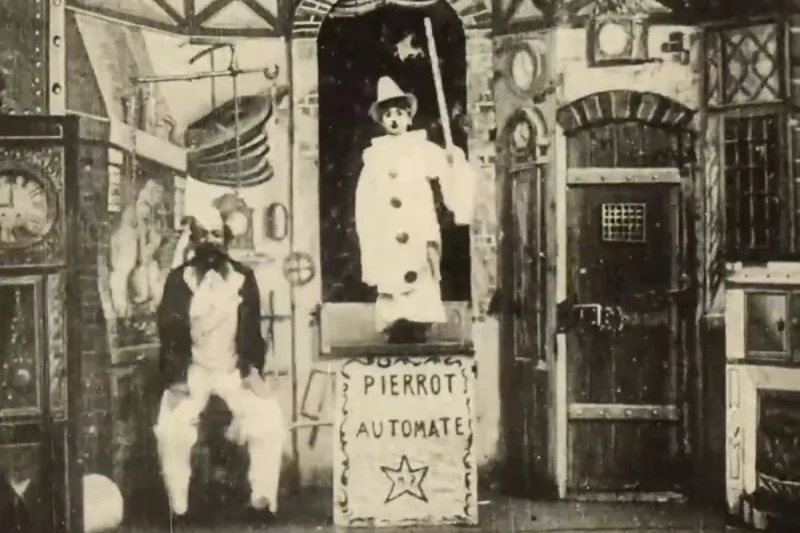
The story of the film ”Gugusse and the Automaton” invites us to reconsider the theme of ”Méliès and the revolt of the machines”, since as early as 1897 cinema unexpectedly touched on the fear of mechanical creatures.
A Discovery at the Library of Congress: Méliès’s Lost Film
Not long ago, the Library of Congress made public what may be the first film about… a robot. (“May be,” because with early cinema one can rarely speak with certainty: it resembles the excavations of Pompeii—something new is always being unearthed.)The story of the discovery, as often happens with early films, is not entirely typical, but neither is it unique. The film had long been considered lost until, in 2025, a man named Bill McFarland from Michigan brought a damaged copy for examination to the National Audio-Visual Conservation Center of the Library of Congress in Culpeper, Virginia. The reels—ten nitrate films stored in rusty cans with faded labels—looked anything but promising.
McFarland’s great-grandfather, William Delile Frisbie (whose name now proudly designates a collection at the Library of Congress), was a teacher and farmer in western Pennsylvania who also worked as a traveling showman and film enthusiast. In the evenings he traveled from town to town with a wagon carrying a projector and a small collection of films, astonishing local audiences with this artistic and technological novelty. After his death in 1937, two small boxes remained containing projectors, films, and notebooks. Among the reels were another film by Georges Méliès from 1900, “The Duel of the Fat and the Lean”, and fragments of an early film by Thomas Edison titled “Burning of the Stables”. The boxes passed from generation to generation until Bill McFarland decided they deserved a proper home.
No one had any idea what was on those reels. Before eventually reaching an institution, they wandered from basements to barns and garages, acquiring a rather miserable appearance. One can easily imagine the reaction of the Center’s staff—and of McFarland himself—when the discovery was finally identified.
Georges Méliès and the Birth of Fantastic Cinema
The film “Gugusse et l’Automate”, created around 1897 in Montreuil, France, is, unsurprisingly, a work by Georges Méliès.This is hardly surprising because Méliès was the magician who transformed cinema from the cold mechanical recording of reality into a world of imagination and fantasy. Although the first narrative film is generally considered to be the Lumière brothers’ “The Sprinkler Sprinkled”, it was Méliès who recognized the trick-based, theatrical nature of cinema and made it the foundation of cinematic language.Disappearances, transformations, sudden appearances from nowhere, seemingly simple plots that conceal deeper meanings and invite repeated interpretation — all of this belongs to Méliès.
We should also remember the emergence of genre cinema. Science fiction, horror, action — all of this can already be found within the miniature one- or two-minute narratives of Méliès’s films. He might even have invented the musical if synchronized sound had existed at the time (the first experiments would appear about ten years later). Yet we already see early dance sequences in his films that sometimes structure the entire narrative — an element that later became central to the musical.
Automatons: Prototypes of Robots Long Before AI
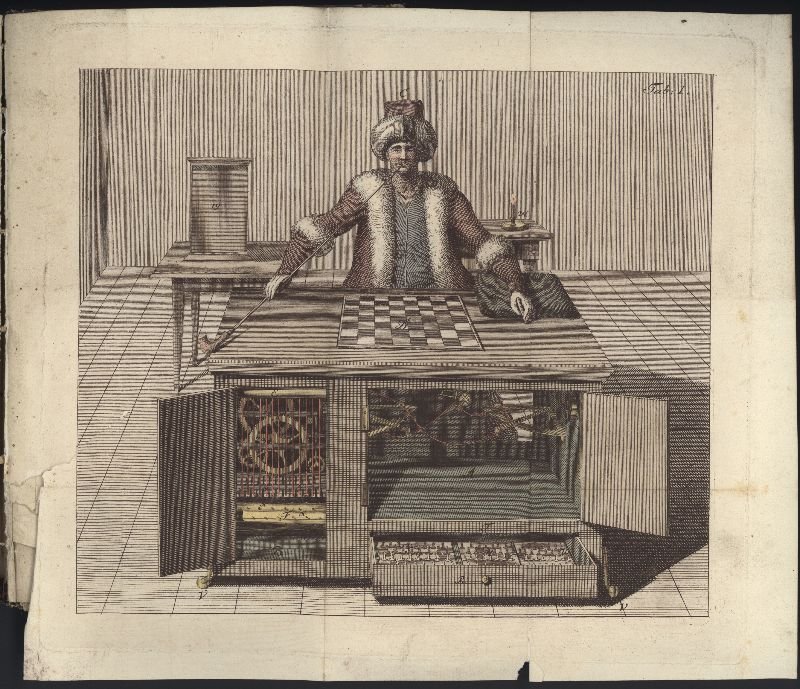
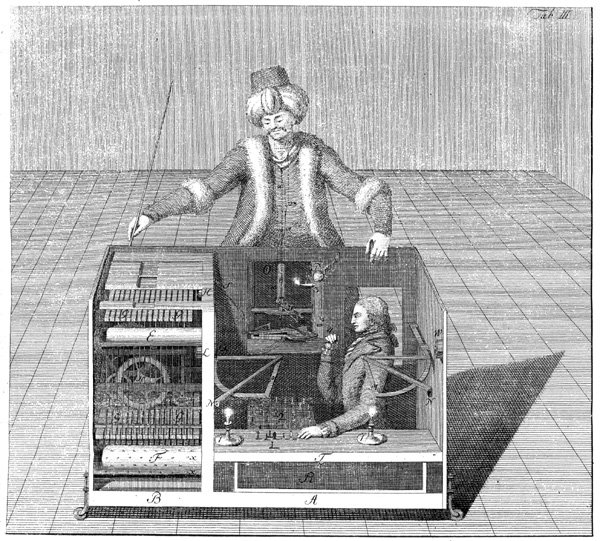
And so we arrive at “Gugusse and the Automaton”.An automaton is essentially a precursor of robots — the term “robot” itself would appear only in 1920 in the play “R.U.R.” by Karel Čapek. Automatons were mechanical dolls capable of performing actions of varying complexity, from clapping hands to drawing or playing chess.Especially popular in the eighteenth and nineteenth centuries, automatons occupied their own cultural niche: as mechanical toys and as characters in literature, visual art, and theater.
Edgar Allan Poe devoted an essay in 1836 to Maelzel’s famous chess-playing automaton, exposing the marvel as a clever fraud. Even earlier came “The Sandman” by E. T. A. Hoffmann (1816), an artistic reflection not only on fascinated yet uneasy admiration of technology that borders on magic, but also on the fragile boundary between the human and the mechanical. Hoffmann’s android Olympia is far from being truly human — her human likeness appears as a disturbing imitation, an intrusion upon humanity itself — yet she manages to pass convincingly as human.“The Sandman”, with its image of the fatal female android, inspired the comic ballet “Coppélia” (1870) and later the opera “The Tales of Hoffmann” (1881).
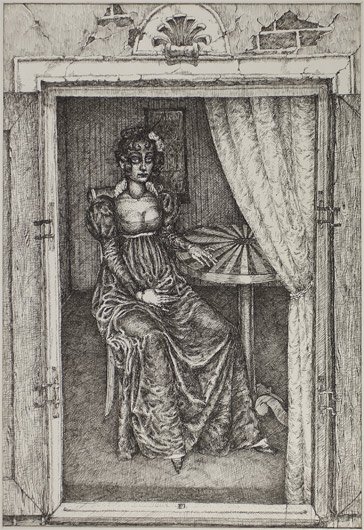
The first film adaptation — more precisely an adaptation of the ballet — “Coppélia, or the Animated Doll” was created by none other than Georges Méliès.
It is therefore hardly surprising that the young art of cinema turned to the theme of the automaton — and even less surprising that the first to do so was Georges Méliès.
A true magician of the screen, Méliès sensed the tension between the magical aura surrounding scientific mysteries and the quasi-scientific explanations behind stage illusions. Using the technological possibilities of cinema, he enthusiastically presented both fantastical and proto-science-fiction narratives to audiences: “The Vanishing Lady”, “The Hallucinating Alchemist”, “The Laboratory of Mephistopheles”, “The Hypnotist”, “The Magician”, “The Astronomer’s Dream”, “The Philosopher’s Stone”, “The Mirror of Cagliostro”, “Modern Spiritualism”, “The Spiritualist Photographer”, “A Trip to the Moon”, “The Mesmeric Experiment”, “The Eclipse”, and many others.“The Automaton” fits perfectly into this universe of fantasies that originated in medieval imagination, were modernized by Enlightenment ideas of progress, and were reinterpreted by Méliès with playful irony and trick effects. Only the figure of the Golem seems missing — a character who would appear on German screens in the following decade after the Great War.
Méliès and the “Revolt of the Machines”: An Early Warning?
The plot is extremely simple — at first glance.The clown Gugusse stands in a workshop filled with clocks, bellows, and tools, a space that somewhat resembles a late-medieval craftsman’s workshop. Beside him stands an automaton — a child-sized Pierrot figure mounted on a pedestal.Gugusse turns a crank. The figure begins to move and to grow. It grows and grows until it reaches the height of an adult man — and then begins to beat its creator.Gugusse removes the figure from its pedestal, suddenly produces an enormous hammer from nowhere, and strikes the rebellious android until it begins to shrink and finally disappears.
Within this one-minute narrative lies the seed of many of the key fears and ideas of the coming century related to robotics and artificial intelligence. A machine created by humans to entertain and assist escapes control and becomes dangerous to its creator, forcing him into a destructive confrontation with his own invention.Here we can already glimpse the future of “Metropolis”, “The Terminator”, “I, Robot”, and even the recent “Play, Enjoy Yourself, Don’t Die” (where the image of an all-powerful AI is also associated with a child). Sometimes it is enough simply to inspire an image with an idea and see what emerges. It is astonishing how much meaning can be contained in an image that seems almost primitive in its simplicity.
Of course, Méliès could hardly have foreseen the full potential of this tiny comic narrative built on transformation and slapstick conflict. Yet artistic genius and the mysterious power of intuition often depict what does not yet exist.Art becomes a kind of medium, a form of artistic spiritualism — although in saying this we risk falling into the same pseudo-scientific mysticism that Méliès himself loved to parody.
In fact, Méliès and the revolt of the machines — that is, his “Automaton” — can be perceived as a parody, paradoxically created before the stories it seems to parody even appeared. Humanity has long felt toward mechanical beings a mixture of fascination, distrust, and suspicion. Only afterward came reflection.Cinema simply followed the same path, and today we can finally see its beginning.
Article on Library of Congress Blogs


 English
  Українська
Great article – thank you for providing this reflective opportunity!