

Leonid Osyka is one of the most important Ukrainian film directors of the second half of the twentieth century and a representative of Ukrainian poetic cinema. In his films, he addressed not only historical and cultural themes but also explored the relationship between humans and nature. Environmental motifs are particularly evident in the film “The Sea” (1978) and “Enter the Suffering” (1987), where the director reflects on the question of human responsibility toward the environment.
In this article, we examine how Leonid Osyka reflected on environmental issues in his work and why these films remain relevant today.
Why Environmental Themes in Cinema Remain Relevant
The problem of the relationship between society and the environment, as well as the practical solutions for its protection, has required human reflection for centuries. However, the corresponding science—ecology—is relatively young; environmental themes in cinema are likewise comparatively recent. All the more significant is the place they have occupied since the second half of the twentieth century—a time when humanity became powerful enough to threaten the very existence of the biosphere.
“Environmental” cinema can be regarded as a modern offshoot of the traditional theme of “human and nature,” a theme that explores both their unity—human beings as part of nature—and their opposition. The evolution of this theme is quite characteristic. In earlier representations, nature was often depicted as a blind and hostile force toward its own “children,” while humans appeared as “noble conquerors,” heroes who refused to submit to it and who fought in an honest “duel” to win their right to survive.
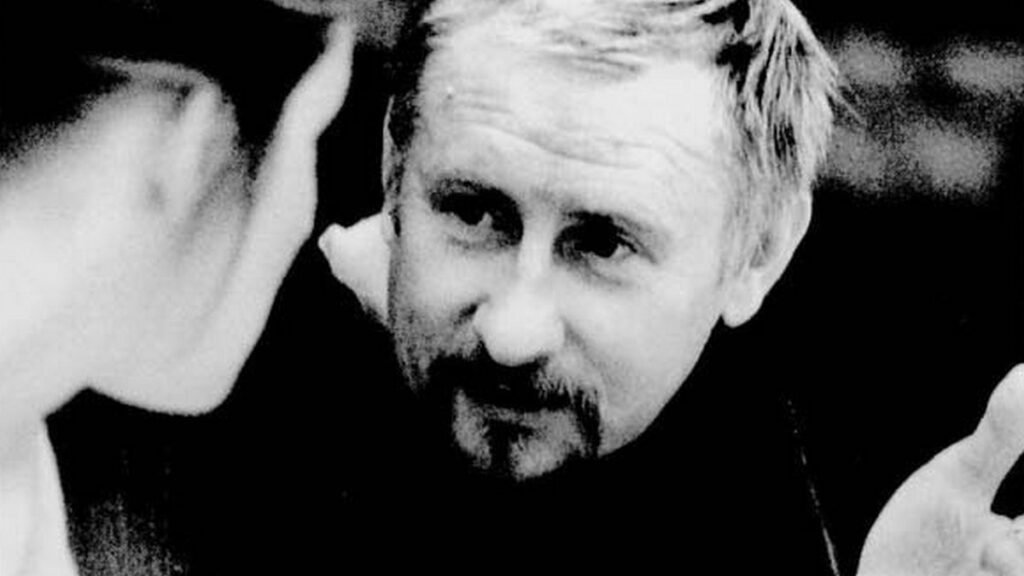
Leonid Osyka — a Director of Ukrainian Poetic Cinema
As human power grew—far from proportionate to human wisdom—it became increasingly evident that nature was the true victim, constantly subjected to attempts at domination and transformation. Gradually, the protection of the environment came to the forefront. Thus, the “+” and “–” signs in the opposition between “human and nature” were effectively reversed. Interestingly, both tendencies, and in the same sequence, can also be observed in the work of the director chosen for our analysis—Leonid Osyka, one of the first filmmakers in Ukraine to explore environmental themes. If in "The Stone Cross" (1968) the peasant Ivan Didukh becomes, in effect, a hostage to his own small plot of land—a personal “Golgotha,” emphasized both by the chosen landscape and the cinematography—then in "The Sea" (1978) the human being appears not as a victim, but as an aggressor.
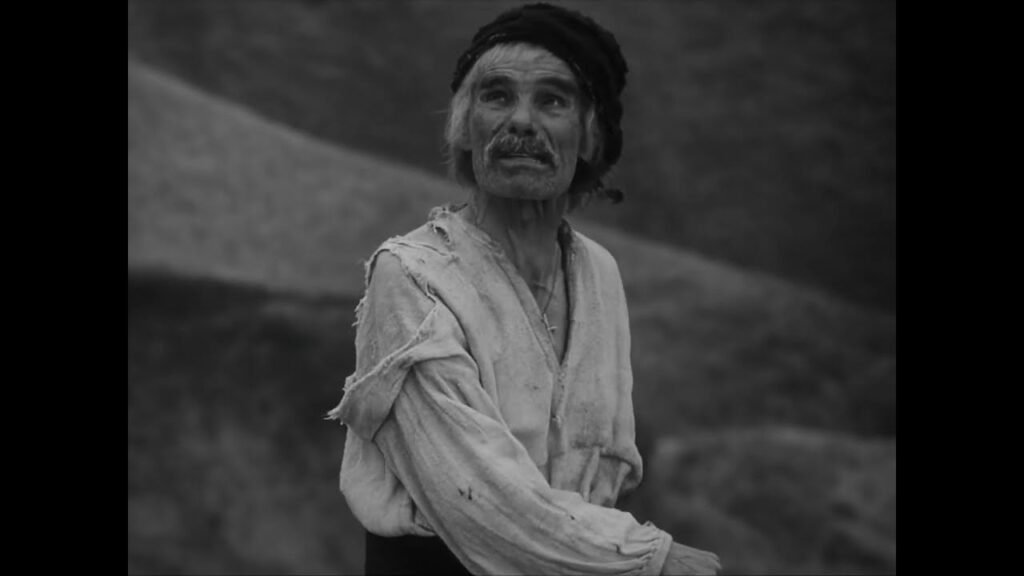
The director’s interest in the relationship between humans and nature is already evident in his graduation film "She Who Enters the Sea". Here, the relationship appears as a harmony of unity. One striking image shows a girl standing on the seashore—a small human figure in harmony with the boundless natural space. Her contact with the sea effectively becomes a metaphor for a child’s entry into the space of life itself. The idea of a harmonious unity between humans and the environment also appears in "Zakhar Berkut" (1971), where the “native” land seems to share the feelings of the Tukhli community (in the final scene, “the mountains cast off their mourning,” as Sergei Parajanov figuratively described it1) and even “helps” them overcome the enemy.
Perhaps this unity appears so unquestionable and convincing because the film depicts a society from a time when people were far more closely tied to their land. A somewhat different picture of peasant life at the end of the nineteenth and the beginning of the twentieth century is presented in "The Stone Cross". Population growth, the exhaustion of the soil, and the general shortage of land—all of this unfolds against the background of colonial dependence on the one hand and historical change on the other, including the declining importance of agriculture and the increasing mobility of people.
All of this contributed to a voluntary or forced separation from the land and to a reassessment of its value: “Now no one needs land anymore—only bills of exchange and banks,” complains the old Didukh, who himself is forced to leave his barren field. Thus, the abandonment of the land is closely connected with a decline in responsibility toward it. By exchanging their rural clothing for “gentlemanly” urban attire, Osyka’s characters move from traditional culture to civilization.The motif of disharmony with the environment then develops into a motif of direct confrontation: while the weak peasant of the previous century fled from harsh natural conditions, the self-confident modern individual seeks to transform them—and, as it turns out, for the worse. This idea is expressed, directly or indirectly, in two of Leonid Osyka’s films that address environmental concerns—"The Sea" and "Enter the Suffering".
The Theme of Humans and Nature in the Work of Leonid Osyka
Environmental themes were indeed explored in Soviet cinema, though they had their own specific character. In a country where “taking favors from nature” was state policy, speaking openly about global environmental problems was necessary—yet impossible. Artists could therefore either engage in abstract reflections on the relationship between humans and nature in general, often limited to hints and metaphors, or address more localized issues, such as poaching.
The choice of a poacher as the main antihero—an enemy of nature, society, and the state alike—suited everyone. Filmmakers could address the painful problem of the criminal exploitation of Mother Nature while also touching upon other, somewhat sharper issues, such as the indifference and negligence of the bureaucratic apparatus and industrial managers. The state system, for its part, was happy to shift the blame onto criminals and its own “prodigal sons,” leaving its essentially poaching-like policies in the shadows. It is therefore symptomatic that representatives of both the “state” and the “anti-state” sectors are combined in one of the first Ukrainian cinematic works devoted to environmental issues—the animated film "Red Pepper" (1961) by Iryna Hurvych and Ippolit Lazarchuk, where the poachers turn out to be the managers of an enterprise that pollutes the environment.
The issue of poaching could be “intensified” by emphasizing its moral dimension—and, at the same time, sharpening the dramatic tension—by turning the poacher into a murderer. This gave rise to films in which the central criminal intrigue is based on the murder of a fisheries inspector: in 1972, "Quiet Shores" by Mykola Vinhranovskyi, and in 1978, "The Sea" by Leonid Osyka (based on the novel "The Reeds" by Eligi Stavsky, who also co-wrote the screenplay).
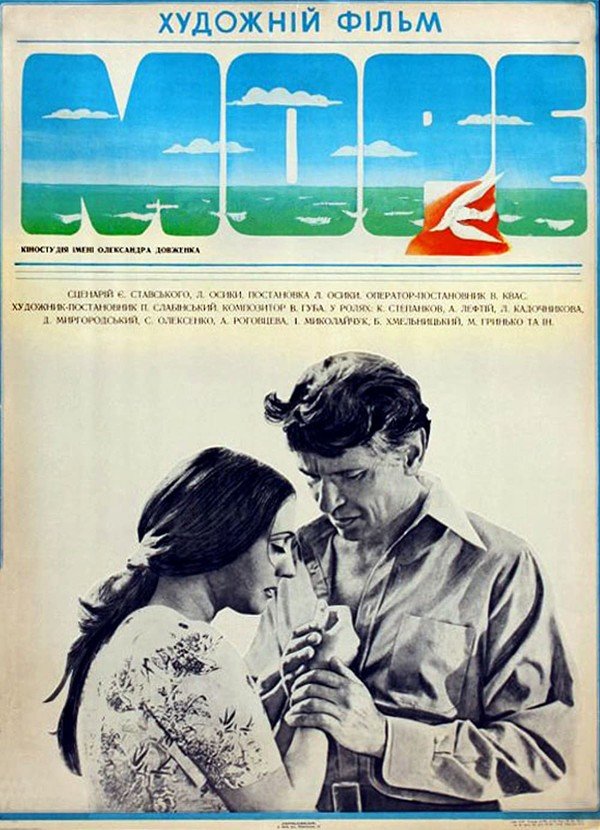
The Film The Sea: The Environmental Problem of the Sea of Azov
Against the now almost classic “poaching” background, the central issue emerges: the preservation and restoration of the Sea of Azov. According to the plot, the construction of a dam across the strait connecting the Black Sea and the Sea of Azov could prove fatal for the ecosystem of the latter, threatening increased salinity and the destruction of several fish species, among other consequences.The film’s protagonist, the writer Viktor Haluzo, becomes interested in the problem and decides to bring it to public attention. Yet while local residents sincerely care about the fate of the sea, it proves far more difficult to encourage society as a whole to defend the natural wealth of their homeland from an internal enemy. In this way, the environmental theme gradually shifts into an ethical dimension2.
Thus, for the director it was not important to create an “eco-industrial film” (the literary source itself belonged to the genre of “industrial” works3), but rather to highlight the problem of humanity’s relationship with the environment: “For us, the main problem is the problem of the human being and his attitude toward nature, of which he himself is a part. The danger lies not in the losses and changes themselves, but in the fact that they occur through human actions…”4. This reflects a characteristic shift in the attitude of the artistic elite toward the idea of “reshaping” nature.
For example, in "Poem of the Sea", released twenty years earlier (script by Oleksandr Dovzhenko and directed by Yuliya Solntseva after her husband’s death), the labor heroism and greatness of the people—their willingness and ability to transform the world around them—were glorified. In a 1951 article, the artist could enthusiastically write: “The era of their [the rivers’ – A.P.] archaic existence is coming to an end. We are transforming them into new systems of water basins, divided by unprecedented dams, and placing them in the rational, reliable, and planned service of humankind.”5.
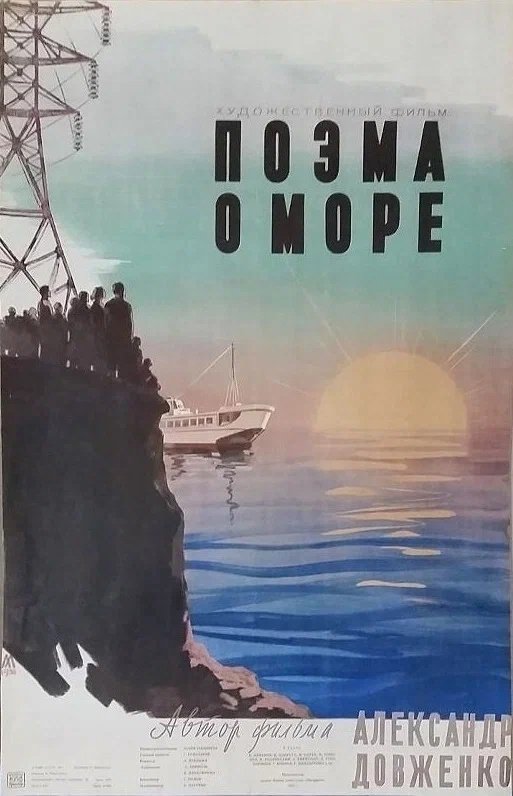
By the 1970s, filmmakers—having witnessed the results of such “reconstructions”—could no longer approach the idea of reshaping the landscape uncritically. The idea of building a dam that might change the very “face” of the Sea of Azov therefore raised concern not only among the authors of the novel and the film based on it, but also for the protagonist and, ideally, for the viewers.In this context, one cannot fail to recall another dam whose consequences have already become apparent. This refers to the island of Tuzla, which began to disappear rapidly as it was eroded due to the construction of a dam. Even today it is impossible to fully calculate the environmental cost of the war unleashed by Russia for the ecosystems of the Black Sea and the Sea of Azov. These are visible consequences of human interference in nature, reinforced by geopolitical ambitions.
“Enter the Suffering”: From Wormwood to Chernobyl
At the end of the 1970s, the idea for Leonid Osyka’s second “environmental” film—"Enter the Suffering", based on the short story of the same name by A. Tkachenko—also emerged. Reflecting on the nine years that passed between the conception of the project and its realization, the director sadly observed that “...the once clear waters of Lake Baikal have grown murky, the Sea of Azov is suffocating, the pages of the Red Book continue to fill, and the sources of communication are drying up.”6.
What particularly attracted the filmmaker’s attention was the latter aspect—what might be called the “ecology of relationships.” If in "The Sea" environmental problems are projected onto the problems of human nature, where the attitude toward nature becomes a metaphor for a selfish and careless attitude toward the world in general, then in "Enter the Suffering" the situation is reversed: relationships between people are associated with their attitude toward the environment. As the director explained, “We wanted to create a psychological parable centered on timeless human problems. It is about the relationship between urban people and nature in difficult, sometimes even extreme conditions. At the same time, it reflects the closeness to nature of those who grew up beside it, those who love it and understand its complex language.”7.

Accordingly, the film presents a conflict between two groups of people: three representatives of “civilization” and four inhabitants of a secluded settlement in the desert. The film employs the structure of a fairy tale: in order to heal her father, the heroine sets out on a difficult and dangerous journey in search of a mysterious species of wormwood; together with the object of the quest—the “lack”8—she also finds a fiancé.
However, this is a “fairy tale in a modern key,” in fact an “anti-fairy tale”: the heroine does not choose the person she truly desires, and the seemingly perfect “enchanted” world collapses upon encountering representatives of the modern civilized world. The destructive force of this world becomes the true antihero of the film, and not only in terms of human relationships.It is therefore no coincidence that, when presenting his new film, Leonid Osyka began by recalling a speech by an ecologist who warned that forests were disappearing at an alarming rate; if this continued, humanity would perish within at most a hundred years due to a lack of oxygen (twenty-eight of those hundred years have already passed — A.K.). According to the director, there could have been no better “preface” to the film9.
The “setting” in which the events of this cinematic parable unfold is the desert. The choice of such a “landscape” is understandable, as this image carries many connotations. It is a conventional, symbolic space: the desert as an embodiment of spatial emptiness. It is also a space of spirituality and purification—one may recall the practices of saints who withdrew to live in the desert; the inhabitants of the Seventh Group likewise possess certain traits of “sanctity” (already suggested by the name itself, with its sacred number seven).The desert is also a space of trial. At the same time, it is a “dead” space, and here the narrative moves from the “ecology of the soul” to the ecology of the environment. A desert is not always the result of natural conditions alone: increasingly, human activity is blamed for the expansion of desert areas, as human management in many cases leads to the destruction of natural systems.
A vivid illustration of such management could be observed by the film crew in Turkmenistan while searching for locations. On the shore of a salty lake in the Karakum Desert stood several gaunt cows, looking bleak and exhausted. The filmmakers were told that, according to the official “production plan,” Turkmen collective farms—like all Soviet ones—were required to keep them. In the alien desert climate, the animals, producing neither milk nor meat, quickly wasted away and died; everyone understood the futility of the enterprise, yet they dutifully followed the directives handed down “from above.”10This was an example of the same “thoughtless administrative zeal” that the director later recalled with bitter irony in an interview11, as did his wife Svitlana Kniazieva—who played Marusia, the embodied ideal of a new “natural human being”—in her memoirs.
Enter the Suffering: The Ecology of Relationships and a Premonition of Catastrophe
The relevance of the “environmental” message of "Enter the Suffering" was confirmed by events that, by a strange coincidence, occurred during the film’s production. Returning from a location search in Tajikistan, Leonid Osyka and Svitlana Kniazieva heard about “some kind of accident at a nuclear power plant.” In Kyiv—gripped by fear in the face of the disaster’s still not fully known, yet already terrifying consequences—the director was writing the shooting script for the film. He even felt a certain sense of relief: at last he had the opportunity to speak with the audience about global problems and to create a film “about the ecology of the human being.”12.
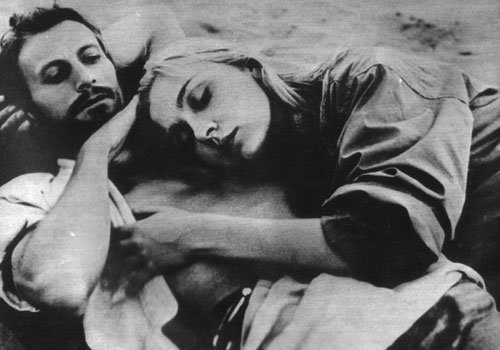
Conceived as a work addressing “universal” human concerns, Enter the Suffering inadvertently became a document of its time and culture (let us allow ourselves this interpretation, justified by the context described above). Interestingly, twenty years earlier another Ukrainian film had already raised the issue of nuclear danger directly. In "The Shore of Hope" (1967) by Mykola Vinhranovskyi, militarists—naturally portrayed as representatives of the Western world—are exposed, while they are opposed by advocates of “peaceful” science, represented by scientists from the USSR and the socialist bloc.
In the same film, the terrible consequences of radiation sickness are shown through the story of random civilian victims of nuclear tests. By a bitter irony of fate, humanity has suffered most not from nuclear weapons, but from the “peaceful atom” (at least for now).It so happened that in his own film—whose production, again by a strange irony, coincided with the time of the Chernobyl disaster and the first wave of its consequences—Leonid Osyka presented as the “antiheroes” precisely the representatives of “peaceful” science. Moreover, they are specialists directly connected with the study and protection of nature: a botanist, a biophysicist, an ecologist. It is they who, quite accidentally and seemingly without even noticing, destroy a small “social ecosystem.”
Why Leonid Osyka’s Films Remain Important Today
Thus, the film moves from the form of a parable to the edge of social criticism. In this regard, one may recall the history of another film that shares much in common with "…the Suffering": the chosen genre of the cinematic parable, the problem of the “urban” individual, and even the sandy landscape. This refers to "A Well for the Thirsty" (1965) by Yurii Illienko, which was shelved because of the same kind of implicit social criticism.The film "Enter the Suffering", however, was created in a different era—the years of perestroika—and therefore had a more fortunate fate.
Like "The Sea", the film had much to say to its own generation, and it still speaks powerfully today. Although we have situated these films within their specific cultural context, the problems they raise have not disappeared—if anything, they have become even more acute. Both consciously and unconsciously, through poaching at various levels of society and through science—whether “military” or “peaceful”—humanity continues to cause large-scale destruction of its environment. At the same time, these issues are being discussed more and more frequently, which offers hope that at least some of these problems may eventually be addressed. Among the first in Ukrainian cinema to speak out on this matter was the classic filmmaker Leonid Osyka.
The work of Leonid Osyka demonstrates that the relationship between humans and nature is not only an environmental issue but also a moral one. In his films, the environment functions not merely as a backdrop for events but as an important element of the artistic world. For this reason, "The Sea" and "Enter the Suffering" can be regarded as early examples of the reflection on environmental themes in Ukrainian cinema.
First published in: Pashchenko, A. The Relevance of Environmental Issues in the Films of Leonid Osyka. Kino-Teatr, Kyiv, 2015, no. 4, pp. 33–36. Published here with minor revisions.
1 Параджанов С. Сходження до майстерності. – Поетичне кіно: заборонена школа. – К.: АртЕк, ред. ж-лу «Кіно-Театр», 2001. – С. 130.
2 Брюховецька Л. Леонід Осика. – К.: Бібл. журн. «Кіно-Театр»; Вид. дім «КМ Академія», 1999. – С. 88.
3 Брюховецька Л. Леонід Осика. – К.: Бібл. журн. «Кіно-Театр»; Вид. дім «КМ Академія», 1999. – С. 87.
4 Леонід Осика: Моральний обов’язок людини. – На екранах України. – 22.10.1977. – № 43 (986).
5 Думы у карты Родины // ЦДАМЛМ України, ф. 690, оп. 4, спр. 64, арк. 18-23.
6 «Кинорежиссер Леонид Осыка». Інтерв’ю В. Болотіна. – Крымская правда. – 5.07.1987.
7 Карасін Б. Сьогодення очима довженківців. – Прапор комунізму. – 28.01.1987.
8 Про структуру чарівної казки див. Пропп В. Морфология волшебной сказки. Исторические корни волшебной сказки. – М. Лабиринт, 1998. – 512 с.
9 Запрошуємо на прем’єри // Радянська Україна. – 27.08.1987.
10 Князева С. Такая вот жизнь и такое кино. По дневникам (1984-1994). – К.: Софія-А, 2010. – С. 157-158.
11 «Кинорежиссер Леонид Осыка». Інтерв’ю В. Болотіна. – Крымская правда. – 5.07.1987.
12 Князева С. Такая вот жизнь и такое кино. По дневникам (1984-1994). – К.: Софія-А, 2010. – С. 164-168.

 English
  Українська