
There’s a common belief that the Soviet era was a “golden age” for animation and animators—a time when artists could create freely and release one iconic cartoon after another. In some ways, that’s true. The state funded production, film studios were active, and animators worked in relatively stable conditions. In fact, many of the cartoons from that era are still a pleasure to watch today—and just as enjoyable to show to kids.But that stability wasn’t always guaranteed. And even in its best years, it came hand in hand with strict censorship.
Another side of the same issue is the relationship with the so-called “brotherly Moscow.” If you start talking about the independence of Ukrainian animation, you’ll often hear about the “close ties” between the Ukrainian and Russian schools of animation. And what is usually meant by that is the idea that animation in Moscow somehow supported, helped, and generally made everything possible—implying that without it, Ukrainian animation wouldn’t have existed at all.So let’s try to sort through these supposed “brotherly ties” and take a closer look at what life was actually like for Ukrainian animation in the so-called “indestructible Union.”
Animation in a Country of (Un)Free Opportunities
The most important question here, of course, is what kind of opportunities animation actually had under the Soviet regime. For our purposes, two key words matter: control and funding.On the one hand, the support really was substantial. The state was interested in cultural production that would promote and glorify it, so animation received significant backing. On the other hand, that same state exercised enormous control over the production process.Interestingly, in the memoirs of Soviet filmmakers you occasionally come across claims that they were luckier than their counterparts in Hollywood. Over there, they would say, producers imposed total control, while in the Soviet Union you could simply receive state funding and create whatever you wanted.
In essence, the Soviet system functioned as a monopoly client and producer, controlling the filmmaking process at every stage and level. In the 1920s this system of control had not yet been fully developed, but there was always the simple option of refusing to release an unwanted film.And yes—unlike in that supposedly terrible Hollywood—you couldn’t just go and find another producer or distributor. What you could do, however, was very easily ruin your career—and possibly your entire life.In the history of Ukrainian animation, admittedly, there were no tragedies on the scale seen in literature, theatre, or even live-action cinema. No one among its leading figures was imprisoned or executed. But that likely had less to do with tolerance and more with the fact that animation occupied a rather marginal position.
As you can probably guess, the situation during the good old bad thirties was at its “most cheerful.” During this time, Soviet—though in reality largely Russian—cinema began to absorb the film industries of the other republics. The autonomy of Ukrainian filmmaking—financial, organizational, and to some extent creative—was gradually lost.This affected animation as well, especially since it had always been treated as a secondary branch of cinema. For a while, animation almost disappeared from the scene altogether. Studio leadership, terrorized and exhausted by the complicated processes of reorganization, had little time or energy for it. And in any case, the conditions for creative work were far from ideal.
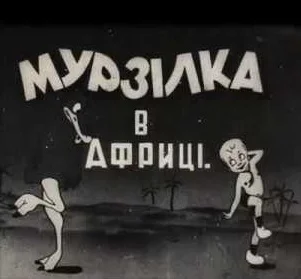
Later, animation was revived—but now it carried the mood of its time. At the Kyiv film studio, films such as "Murzilka in Africa" ("Мурзілка в Африці", by Yevhen Horbach" and Semen Huietskyi, 1934) were released, telling the story of an African child rescued from a white colonialist by Soviet pioneers. Then there was "Tuk-Tuk and His Friend the Beetle" ("Тук-Тук та його товариш Жук", by the same directors, 1936), made in the tradition of the so-called “defense film.” Another example is "Forest Agreement" ("Лісова угода", by "Ipolit Lazarchuk" and Yevhen Horbach, 1938), with a fairly transparent political subtext.There were, of course, other animated films as well—but they did not receive the same level of support or success. One of the best among them, "The Magic Ring" ("Чарівний перстень") by Semen Huietskyi, was banned for “nationalism.”
And now we finally arrive at the subject of bans.A striking example is the work of the “father” of Ukrainian animation, Viacheslav Levandovskyi. His film "Ukrainization" ("Українізація", 1927), devoted to the policy of the same name, was banned along with the policy itself. The seemingly harmless "The Tale of the Housekeeping Squirrel and the Villainous Mouse" ("Казка про білку-хазяєчку та мишу-лиходієчку", 1928) was also banned—because critics claimed it contained “a number of tendencies of kulak ideology.”Today that accusation sounds rather absurd, but at the time it was serious enough to make anyone think twice.In the autumn of 1935, the journal "Soviet Cinema" ("Радянське кіно") published an article titled "Animated Film in Ukraine" ("Рисований фільм на Україні"). It explained in detail how incorrectly animation had supposedly been made in Ukraine all those years.
They went through everything—from the completely innocent “jointed method” (the cutout animation technique) that the master used, all the way to the content of the films themselves. They also mentioned him “in a mild and polite tone,” along with his banned works. Interestingly, in both cases it was acknowledged that the films were technically and artistically quite strong. But once the labels of “nationalism” and “kulak ideology” were attached, neither the films nor their author had much hope for a positive outcome.Let me quote a passage from that article so you can get a sense of its style and substance:“The ideological and political guidance of the animation sector was not at the proper level, which resulted in a long series of deviations and mistakes that more than once reduced the results of the stubborn, painstaking labor of animators to the level of ‘products for the shelf’… Thus, at the same time, the question arose of organizing and educating creative cadres of animators—our own, fully Soviet people—capable of producing works that are both ideologically sound and artistically strong.”

In short, the following year Levandovskyi was already in Moscow. In his place, the authorities clearly wanted to see a new generation of animators—one that would produce films like "Political Review" ("Політогляд") and "The Second Collective Farm Spring" ("Друга колгоспна весна")—the very films that the article had praised, albeit cautiously.More broadly, if you read between the lines, animation was expected not merely to indulge in artistic experimentation but to get down to business—that is, to serve the needs of scientific and technical cinema.[1]Articles like this were never published by accident. They were a kind of warning bell: first came the devastating critique, and then either “correction”—or the corresponding consequences.
Within just a few years, animation in Ukraine would indeed be reduced to little more than an auxiliary branch of technical cinema. Animators tried to keep working, but it was becoming increasingly difficult.At the Odesa film studio the situation was even worse. Even the well-known Moscow master "Yurii Merkulov" attempted to organize an animation workshop there, but the studio management—and the leadership of the Ukrainian film industry more broadly—showed little interest in it.[2]Soon afterward, the department responsible for hand-drawn animated films at the Kyiv film studio was shut down altogether: animation was deemed unprofitable by the management (the broader climate of repression, of course, also played a major role). For a long time afterward, animation work in Ukraine was reduced to servicing popular science and educational films.
With the exception of Ipolit Lazarchuk, the leading directors eventually left. After being branded and having "The Magic Ring" ("Чарівний перстень") banned, Semen Huietskyi devoted himself to painting.After the shutdown of artistic animation in Ukraine, Yevhen Horbach remained at the film studio for some time before the war. But he was no longer working as a director—only as the senior cameraman in the technical animation department of the studio for educational and technical films. Eventually, he left the film industry as well and also worked as an artist. According to his daughter’s recollections, he abandoned filmmaking largely out of fear—afraid of repression.[3]
In short, the 1930s were not the best time for Soviet animation—and Ukrainian animation was no exception.
It wasn’t until 1959 that a department for artistic animation was opened at the studio "Kyivnaukfilm", following a resolution by the Council of Ministers of the Ukrainian SSR. Ukrainian animation was revived in a somewhat softer political climate, though unpleasant moments were still unavoidable.The main issue lay in the system of control and censorship, under which a project could be killed off at virtually any stage of production. Admittedly, animation did not attract quite the same level of scrutiny as live-action cinema.
Here another stereotype came into play—the idea of animation as “children’s art,” just “cartoons.” Because of this, it was treated less strictly, and animators could work with considerably more freedom. Just as importantly, there was far more freedom when it came to visual experimentation.In live-action cinema, anything labeled “formalism” was treated with great suspicion—which is one reason directors like Sergei Parajanov were so disliked by the authorities. In animation, however, artists could experiment much more freely with form and develop new ways of visual expression.[4].
But even there, all sorts of things could happen, and some cases today sound almost like anecdotes.For example, "Why the Rooster Has Short Pants" ("Чому у півня короткі штанці") by Tsezar Orshanskyi was criticized in 1966 for making excessive use of “applied art.” The film also ran into trouble over alleged “Ukrainian nationalism.”[5]"Mystery-Bouffe" ("Містерія-Буф") by David Cherkaskyi (1969) was rejected in Moscow with an almost textbook demand: “the film must clearly express a class position.”The studio director, Borys Ostakhnovych, stood his ground—and as a result, the film never made it to the all-Union screen.
Particularly vigilant cultural officials also knew very well what Aesopian language was—and could spot it in the most unexpected places.A particularly anecdotal case involves the film "The Little Goat and His Trouble" ("Козлик та його горе") by Leonid Zarubin (1976). The director ran into trouble because the goat in the film had a red balloon that burst, and he was then given two new ones—yellow and blue.A threat to the state, apparently! Good thing it wasn’t the 1930s.
Yevhen Yakovych Syvokin also has his share of amusing stories about dealing with censorship, which he recounts in various interviews. One of them is the story of “him and the Beatles.”His film "Fragments" ("Осколки") initially ran into trouble because it used music by "The Beatles". Officials wanted the music removed—but the situation was saved by the Beatles themselves. Cultural bureaucrats learned that the band supposedly donated part of their royalties to the Communist Party of Great Britain. I’m not sure whether that’s true or not, but the film was ultimately left alone.Other films were less fortunate, however. "Good Name" ("Добре ім’я", 1971) and "The Tale of the Kind Rhinoceros" ("Казка про доброго носорога") ran into serious problems. In "The Rhinoceros", officials believed they detected a hint of dissidents, and the director was consequently declared “non-travel eligible” until 1980—meaning he was barred from leaving the country.[6].


There was also another rather unpleasant nuance: the obligation to produce openly ideological content. Creative freedom was all well and good, but at least one “cartoon” on a heroic-patriotic theme each year had to be made.This heroic duty was taken on by the head of the animation unit, Iryna Hurvych. And we do mean heroic, because it actually required a certain degree of self-sacrifice. Creating animation is extremely meticulous and labor-intensive work, and naturally everyone wanted to realize their own ideas, not carry out a party commission.So the senior masters—Iryna Hurvych, Tadeusz Pavlenko, and Nina Vasylenko—took on the production of films such as “Salutes” (1975), “Budyonovkas” (1976), and “October March” (1977).As a result, the younger animators had much freer hands to pursue their own projects.[7].
A Bit About the “Brotherly Ties”
Another painful topic is the “brotherly ties” between Ukrainian and Russian animators. At first glance, what could possibly be wrong with them? Seemingly nothing…Except that these ties created the illusion of a shared creative space, of the two animation traditions somehow forming a single whole. And in the end, we get odd situations like “joint statements by Russian and Ukrainian animators” regarding Russian aggression.[8].
Contacts between animators from different republics—or, to put it less politely, between the Russian “center” and the Ukrainian province—were, of course, active and strongly encouraged. And just as naturally, they tended to follow the pattern of Russian paternalism.Some Ukrainian artists received their education in Moscow—for example, Nina Vasylenko and Olena Barinova. Radna Sakhaltyuev, a representative of the Buryat diaspora in Ukraine, one of the key artists of the Kyiv animation school and a longtime collaborator of David Cherkaskyi, came to Ukraine after studying at VGIK.
If we speak about broader influences, Russian animation centers sometimes served as a kind of “school” for Ukrainian ones. This was especially true in the 1930s, when Ukrainian animation was transitioning from the cutout technique to hand-drawn animation, and again during its revival in the 1960s.At that time, Ukrainian animators underwent something of a “training period” at Soyuzmultfilm. For example, Eduard Kyrych recalled that, on the technical side, they received significant help from masters such as Fyodor Khitruk, Popov, Ivan Ivanov-Vano, and later Yuri Norstein and his wife Francesca Yarbusova.Along with that assistance, Russian culture was naturally promoted as well. As Eduard Kyrych once put it in an interview: “We were raised within the framework of Russian culture; only a few of us truly became attached to Ukraine.”[9].
But as the work of a number of artists—including Eduard Kyrych himself—shows, this did not prevent them from creating animation with a distinctly Ukrainian character.In reality, what animators gained at the Moscow and Leningrad studios was primarily technical knowledge: familiarity with the technology and an understanding of the very process of “bringing drawings to life.” When it came to artistic solutions, those were developed within the animation school itself.Of course, in the early years—during a kind of apprenticeship period—outside influences were noticeable. But they were not so much Russian as… American.
So when it comes to the “lessons” of “Soyuzmultfilm,” as people like to say today, “it’s not all so straightforward.” Because Soyuzmultfilm itself, in turn, drew heavily on the “school” of Disney.[10]For example, David Cherkaskyi described his entry into animation briefly and clearly: “They took us to Moscow and showed us Disney, and I was blown away. That’s how it all started.”He also said: “For me, the main teachers were Disney and Dyózhkin.” (It’s worth adding that Dyózhkin himself was essentially a “student” of Disney.)A funny detail, by the way: in one interview Eduard Kyrych recalled how much he, as an animator, had learned from Disney’s “Snow White and the Seven Dwarfs.” He even called it “the very first film of my life.”[11]And here’s where the humor of the situation lies: one of the artists behind “Snow White and the Seven Dwarfs” was the ethnic Ukrainian Volodymyr Tytla.Quite an interesting twist…
So, Ukrainian animation owed “Soyuzmultfilm” a certain amount in terms of training—and, to some extent, for introducing it to Disney. But how much credit should actually go to the Soviet system, and to Russia in particular?Very little, in fact. Because it was precisely that same Soviet (Russian) system that cut Ukrainian animation off from the wider world.Here it’s worth quoting the recollections of Mykhailo Titov:“…the first generation of Ukrainian directors was cut off from the global information space. We existed in isolation: we did not see the animation being created in other countries. The only thing available to us was something quite old—Disney films.”[12].
Of course, this does not mean that Ukrainian animators never saw world animation at allі. There were certainly some points of contact—film festivals, for example.Volodymyr Dakhno himself recalled the “Zagreb school” as a source of inspiration for the visual style of the first episode of the cult series “Cossacks” — “How the Cossacks Cooked Kulish.”[13]It is worth adding that animation in the Soviet sphere was somewhat lucky that such a modern and impressive movement flourished in Yugoslavia, on this side of the “Iron Curtain.” In other words, it was a “friendly” animation scene, one that could be openly referenced without fear.Disney, by contrast, was in reality something of an “uncle” of Soviet animation, but people tended to speak about him somewhat through clenched teeth—as a product of “damned capitalism.”
Now let’s say a few words about the Ukrainian contribution to Russian animation. As was probably the case in many fields—and certainly in the arts—masters of Ukrainian origin often worked actively in the metropolis.Ukrainian specialists in various roles made significant contributions to Russian animation. For example, in the first artistic animated film produced in the USSR, “Soviet Toys” (1924) by Dziga Vertov, the artist was Oleksandr Bushkin (1896–1929).Bushkin was a native of Kyiv who studied at the Kyiv Art School, and later worked as a stage designer in clubs and propaganda centers.
At the age of 26, in 1922, he moved to Moscow. There he became one of the organizers of animation production at the “Goskino” film studio.He created animated inserts for technical films as well as very short advertising film posters, usually lasting 50–90 seconds.[14]After that, he began collaborating with Dziga Vertov, creating animated sequences together with him, and later became a director himself.For example, in that same 1924, he made “The Mysterious Ring, or the Fatal Secret,” a film that playfully reworked the Western genre and the kind of trick-driven plots typical of it.
Next comes the already mentioned Viacheslav Levandovskyi. Since no proper creative conditions could be found for him in Ukraine (and we should also remember that the repressions were already underway), he moved to Moscow in 1936, where he initially continued working in animation.He worked at “Mosfilm” (Art Production Unit No. 5), under the supervision of another Ukrainian, Oleksandr Ptushko. During this period he produced three works in the technique of puppet animation,[15]among them was the first color animated film produced at “Mosfilm,” created using the Mershin method.
Among the important figures in the history of “Soyuzmultfilm” were several people of Ukrainian origin, including Dmytro Babychenko, Mykhailo Tsekhanovskyi, and Oleksandr Ptushko—a landmark figure not only in the history of Soviet fairy-tale cinema but also in stop-motion animation.Another notable figure was Oleksandra Snezko-Blotska, a well-known screen adapter of ancient myths, who was born in Vovchansk. Incidentally, it is interesting that mythological images are also depicted on the coat of arms and flag of her hometown, Vovchansk.
All of this concerns the early generation of Soviet animation. Much closer to our own time are the Kyiv-born Oleksandr Tatarsky and Ihor Kovalyov, who moved to Moscow in the early 1980s, worked at the animation studio “Ekran”, and in 1988 founded the famous Moscow studio “Pilot.”In their story—and in Levandovskyi’s as well—the blame does not lie solely with “bad Russians.” These animators moved in part because they could not find a proper place within the filmmaking system in Ukraine.At the same time, we should not forget that the Moscow “center” had a clear interest in keeping Ukrainian cinema—including animation—essentially provincial.
“Soviet,” “Ours”… Or, A Few Words About the Rhetoric
In 1986, a certain Sergei Asenin published a book titled “The World of Animation.” It is quite revealing how, in describing the birth of animation in the USSR, the author consistently writes only about “Soyuzmultfilm,” the studio based in Moscow.It is as if animation in the other republics did not exist at all—with the sole exception of a brief, passing mention of Georgian animation. And only around page 80 does the author finally mention the “republican” schools of animation, all in one sweep. Even then, he does not forget to emphasize how “Soyuzmultfilm” provides them with creative and technical support—and that together they produce roughly as much as Soyuzmultfilm alone.[16].
Interestingly, in his 1974 monograph on the history of animation,[[17] the concept of “Russian” animation does not appear at all. Instead, it is presented simply as “Soviet” or “ours.” In other words, “Russian” and “Soviet” were effectively treated as interchangeable.Were other national animation traditions mentioned there? Yes. But they too were described as Soviet! Which, in effect, made them Russian as well, in a certain sense. An interesting kind of arithmetic.Incidentally, when speaking about animation in the republics of the USSR, the author refers only to “studios” and “departments,” not to fully developed national animation schools.
At first glance, one might ask: why devote so much attention to a book published several decades ago? The reason is that it represents a vivid example of the narratives—more broadly Soviet, and more narrowly Russian—about national animation schools within the USSR. And that narrative is still “more alive than all the living.”Out of curiosity, the author decided to google one of the cult Ukrainian Soviet animations—the dilogy “Alice in Wonderland” and “Alice Through the Looking Glass” by Yefrem Pruzhansky—to see how foreign reviewers and viewers actually classify it.
There was a bad feeling about this—and it turned out to be justified. True, this little investigation was limited to the English-speaking segment, but one can assume it is fairly representative.The studio “Kyivnaukfilm” is often listed as the producer, but the “Kyiv” part of the name (or rather “Kiev”) tends to be treated, to put it mildly, as a mere formality. As for “Alice” itself, it is usually described as Soviet, and sometimes even Russian.In principle, that tells you everything you need to know about our cultural policy abroad.


Although the situation is now improving somewhat—sadly enough, thanks to the war. Once again, looking at the English-language segment of the Internet, one can already find a few articles dealing specifically with the history of Ukrainian animation.In one of them, Ihor Kovalyov was even described as a “Ukrainian filmmaker.”So there is clear progress.[18]Overall, we still need to actively work to promote Ukrainian narratives about Ukrainian animation. Because in the world today, the Russian “optics” on this subject remain very strong.
Here is another telling example: in some English-language books that discussed Ukrainian animation, the supposed “original film titles” were given in Russian transliteration.[19] In other words, the authors had clearly worked from Russian sources, apparently not even recognizing the difference between the Russian and Ukrainian languages.One can only imagine, then, how clearly they distinguish between the Ukrainian and Russian cultural spaces more broadly. It also becomes easier to understand why many people simply accepted that supposed “joint statement by Russian and Ukrainian animators.”In short, we must keep chipping away at this rock. And we must love and defend our animation.
[1] Лойко Г. С. Рисований фільм на Україні // Радянське кіно. – 1935. – № 3/4. – С. 46-47.
[2] М. Б. Зміцнити молоду майстерню // Радянське кіно. — 1937. — № 6, верес.–жовт. — С. 62.
[3] Орел Світлана. У нас міг би бути свій Волт Дісней… // https://dt.ua/personalities/u-nas-mig-bi-buti-sviy-volt-disney-250965_.html
[4] Іволга Л. Українська радянська анімація 1960-1980-х років у тоталітарному режимі // http://conferences.neasmo.org.ua/uk/art/751
[5] Цезар Оршанський. Спогади доньки // https://m.facebook.com/nt/screen/?params=%7B%22note_id%22%3A869574910517086%7D&path=%2Fnotes%2Fnote%2F&_rdr
[6] Іволга Л. Українська радянська анімація 1960-1980-х років у тоталітарному режимі // http://conferences.neasmo.org.ua/uk/art/751
[7] Іволга Л. Українська радянська анімація 1960-1980-х років у тоталітарному режимі // http://conferences.neasmo.org.ua/uk/art/751
[8] Hundreds Of Russian and Ukrainian Animation Artists Join Together To Condemn Russia-Ukraine War // https://www.cartoonbrew.com/politics/hundreds-of-russian-and-ukrainian-animation-artists-join-together-to-condemn-russia-ukraine-war-213795.html?fbclid=IwAR3kLzsx_8ylVWy5Imp8Pu7qREpvVrHKq6jjqjuTRxb9vUvswz3hiBrYk_I
[9] Едуард Ілліч Кирич. «Енеїда» – це порівняння українців із древнім народом. Розмовляла Л. Іволга // https://ivolga-lilia.livejournal.com/287.html#comments
[10] Володимир Дахно: “Мій почерк – український” // https://www.kinokolo.ua/interviews/66/?fbclid=IwAR1tT8abejhOWp85hqfnhMDl9NCV_ivpcmYY7_gRu7pCrpk9in3D79hCqpA
[11] Едуард Ілліч Кирич. «Енеїда» – це порівняння українців із древнім народом. Розмовляла Л. Іволга // https://ivolga-lilia.livejournal.com/287.html#comments
[12] Михайло Тітов. – «Кіно-Коло» . – №7-8. – 2000. – С. 88.
[13] Дахно В. Мій почерк – український // https://www.kinokolo.ua/interviews/66/?fbclid=IwAR1tT8abejhOWp85hqfnhMDl9NCV_ivpcmYY7_gRu7pCrpk9in3D79hCqpA
[14] Лебедева К. З чого починалась українська анімація // https://amnesia.in.ua/animation
[15] Лебедева К. З чого починалась українська анімація // https://amnesia.in.ua/animation
[16] Асенин. Волшебники экрана (1974). – С. 80.
[17] Асенин. Волшебники экрана (1974)
[18] Know Your Indie Filmmaker: Igor Kovalyov (cartoonbrew.com) // https://www.cartoonbrew.com/know-your-indie-filmmaker/know-your-indie-filmmaker-igor-kovalyov-213806.html
[19] Cowen Eleanor. Animation Behind the Iron Curtain; Bendazzi Giannalberto. Animation: A World History: Volume III: Contemporary Times


 English
  Українська
1 thought on ““Радянські мультики” і радянська цензура в підрадянській Україні”