

Un hiver russe | A Russian WinterCountry: FRA 20262026Director: Patric ChihaPhoto description:Section: Panorama 2026File: 202615476_1© AURORA FILMS
“Good Russians” as a Comfortable Western Narrative
The film “A Russian Winter,” directed by Patrick Chiha and presented at Berlinale, offers Western audiences a familiar image of “good Russians” in exile. But when viewed from a Ukrainian perspective, a far more complex question emerges — one of responsibility, position, and the limits of empathy.
I’ll write to you about “A Russian Winter.” I haven’t seen “Mr. Nobody,” but judging by the descriptions circulating online, the overall picture feels painfully familiar. “A Russian Winter” (Un hiver russe / A Russian Winter), directed by Patrick Chiha, is a French documentary about “good Russians” in exile, presented at the Berlinale in the Panorama section. (Yes, the very same program that also featured our “Traces,” about Ukrainian women affected by Russian violence.)
Artistically, the film is quite strong, and its protagonists are likable — the musician Yuri and the artist Margarita, who, after the start of the full-scale invasion, realize they can no longer live in Russia and leave the country. Margarita even took part in protests and was arrested (in fact, the fear she experienced then is what pushed her to leave); Yuri doesn’t speak about his own involvement, but one can assume he protested as well — at the very least, he recalls his disappointment at how few people took to the streets at the time. (A feeling, I believe, many of us share.)They are interesting, artistic, somewhat infantile — a perfect combination for the image of a Russian migrant.
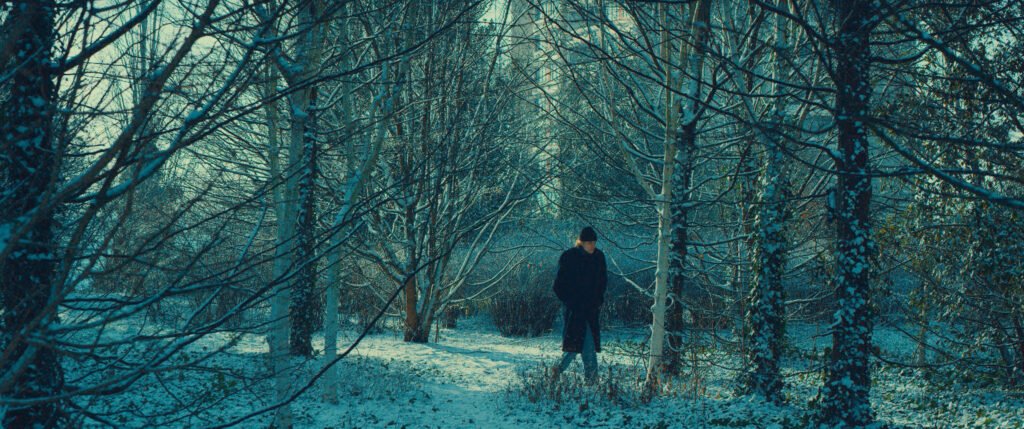
Country: FRA 20262026
Director: Patric Chiha
Photo description:
Section: Panorama 2026
File: 202615476_2
© AURORA FILMS
This is the overall picture designed for a Western audience. But for Ukrainians, a beautiful surface is never enough — give us a magnifying glass, let us go over the fine details, and ideally look beneath that polished exterior. And here are a couple of such details.The film opens with Yuri reflecting on previous generations (whether his own family or Russians in general — it hardly matters).
According to him, they were born and raised in servitude — but what could be done, those were the times, no one is to blame. (Not a direct quote, but that’s roughly the idea.) It feels like a parody of amor fati: accept and love your fate, because who are you to change anything? Russia has always had this servitude; people struggled a bit to change things, it didn’t work — so what can you do?Perhaps this moment wouldn’t be worth much attention, if not for another remark that is far more infuriating: Yuri admits that he is not currently engaged in any political activity and has no intention of “atoning” for collective guilt.
There are, after all, Russians who have dedicated themselves to this “atonement” — but no matter how much they do, it is taken for granted, and their efforts are always “not enough.” So what’s the point?..In other words, a person who has distanced himself from everything around him, while still maintaining the pose of a “victim of the regime,” ends up devaluing the efforts of those who are actually trying to do something. God knows, there are already very few genuinely “good” Russians (without quotation marks), and they are barely visible in the public sphere — unlike the followers of Navalny.
It would be funny (actually, not at all) if one of those rara avis, under the influence of the “power of art,” decided to abandon their activism altogether and simply live their life like Yuri.It makes you think: we will probably never see films about the Russian Volunteer Corps or “Free Russia,” nor about Russian decolonial activists or members of Indigenous movements in Siberia. Because those would be stories from the category of “we don’t need your pity” — more than that, “we need to act” — rather than the comfortable, mass-friendly idea of the “little person” who bears no responsibility and has no power to change anything.
Episode two, which is easy to connect ideologically with the previous one. Russian migrants from Yuri’s circle talk about their families torn apart by the war: men who do not want to go to the “special military operation” leave the country under loud curses from their “patriotic” relatives, while fathers and uncles take up arms in their place.What’s striking is that this is not told with pain or horror, but with a kind of embarrassment, carefully masked by irony.
Схоже, сильні почуття та дії в цієї категорії “нє в чєсті”. Хто зна, чому. Може, вони псують позу “мудреця, піднесеного над метушнею цього світу”? Симптоматично: це не заважає одному з “пацифістів” сперечатися з родиною через виплати за вбитого на війні батька. Відмовлятися від кривавих, зароблених на неправедній війні ціною життя баті грошей? Ні, от сюди уже принцип “неучасті” не мішайте!
Emigration Without Solidarity with Ukraine
The next scene. Yuri and Margarita talk about a Ukrainian woman who thanked them for leaving, for their stance. Both understand that “they [that is, we] need support,” but… the woman misunderstood them. Their departure is not an act of solidarity with Ukraine — they simply “couldn’t do otherwise,” couldn’t remain in what Putin’s Russia had become.The conclusion for Ukrainians? These people are not our enemies, but neither are they our friends. Not even situational allies, given their stance of “we owe nothing to anyone” and the tendency to claim the position of “victim” for themselves. We have our path, they have theirs — and it may be best for everyone if these paths do not intersect.

Country: FRA 20262026
Director: Patric Chiha
Photo description:
Section: Panorama 2026
File: 202615476_3
© AURORA FILMS
The Symbolism of Suitcases: What Russians Take with Them into Exile
The final moment, almost lyrical. At the end of the film, Margarita retrieves her belongings from a storage unit in Turkey — her “transit point.” I’ll admit: as someone who lacks the skill, time, or inspiration to “look stylish,” I found myself admiring Margarita’s sense of dress throughout the film — truly, an artist!
But one question kept lingering: how did a refugee with no visible means of support manage to have such a wardrobe? The answer turned out to be simple — she brought it all with her from home. Along with a whole pile of other belongings: one detail that caught the eye was a small ornate hanger or stand — perhaps a family heirloom, otherwise why carry it such a long way?In the final scene, she drags this heap of her belongings out onto the street, where a car is presumably meant to pick her up — and she waits, and waits, and waits…
The meaning is generally clear: having lost “her” world, she carries its fragments with her like a snail — a vulnerable, helpless human being whom it is simply impossible not to feel sympathy for.At the same time, a certain “Ukrainian lens” compels one to see a very different symbolism in this image. When you are fleeing shelling — especially with children — there is no room for monstrous piles of belongings: you very quickly determine what truly matters and take only the bare essentials needed to survive.
Do you remember Sergey Ponomarev’s 2023 photo project RELOCATED? Russian celebrities with the items they took with them into exile? There were frying pans, tennis rackets, stuffed toys… It was that story — which sparked so much irony among Ukrainians — that came to mind here.It’s hard not to read into this a broader inability of Russian society, even among its “best” representatives, to distinguish what truly matters in life: from the most valuable possessions to core values — ultimately, what is worth letting go of and what is worth fighting for.And so the film’s title acquires a subtext clearly not intended by its author: it was meant to be about the winter of a regime, but turns out to be about the winter of a collective soul.

 English
  Українська