
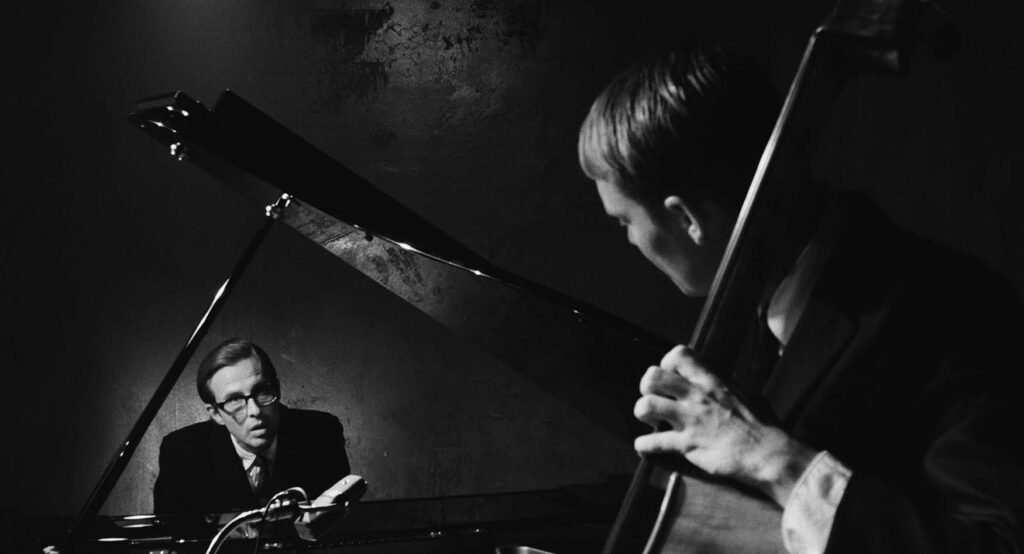
I don’t know who will receive the “Bear” for Best Cinematography, but I think I already know my personal favorite. "Everybody Digs Bill Evans" by Grant Gee is a deep psychological drama about a period in the life of jazz legend Bill Evans, when—after a creative breakthrough—he tragically loses his musical brother, the bassist Scott LaFaro, and takes a “pause” in life and, most importantly, in music.

Country: IRL, GBR 20262026
Director: Grant Gee
Photo description: Grant Gee
Section: Competition 2026
File: 202606467_8
© Shane O’Connor
Cinematographer Pierce McGrail orchestrates the visual composition: black-and-white imagery complemented by color flash-forwards. The latter further emphasize the noble restraint and expressiveness of the black-and-white visuals: the monochrome evokes the early 1960s, when the main events unfold, while the color flashes are stylized in the technologies and aesthetics of the 1970s.
I love black-and-white cinema. In fact, there is Black-and-White Cinema and black-and-white cinema. The former refers to quality films from roughly the 1920s to the 1960s, when filmmakers thought artistically in monochrome and worked with it organically and effortlessly. In such films, you hardly notice the “absence of color”: it simply isn’t needed, because they were shot with the interplay of black and white gradations in mind. That’s why colorizing such films has always seemed to me like bad taste—it’s like taking a black-and-white engraving and coloring it in like a page from a coloring book. This category also includes the finest examples of films shot in black-and-white in later decades, when color had already become the default.
“b/w” (in lowercase) can mean mediocre, artistically unremarkable imagery. And then there is “b/w” in quotation marks—pretentious, dull, flat pictures “without color.” But let’s not dwell on that. Let’s talk about Bill Evans. Nearly every frame here feels like a work of black-and-white photography: you want to pause the film to examine the details more closely, to admire the play of light and shadow, to almost physically feel the textures. The image breathes and glows from within.
It draws you in so deeply that you almost forget to follow the plot. That is perhaps the only “flaw” of the cinematography—though I want to stress that the refined visual language is far from the only strength of the film. This is a powerful story of psychological “clinical death” and the gradual, very slow and difficult return from it. The pacing is beautifully unhurried, yet the internal tension is so strong that your attention never falters for a moment. And, of course, the music—around which the hero’s life revolves and which ultimately lies at the heart of the film. The compositions of the Evans Trio function as a separate character in the film, and it is with one of them that we will conclude this short review. Just listen to Jade Visions by the Evans Trio—it will tell you more about the film and its mood, deeper than any film criticism ever could.
Country: IRL, GBR 20262026
Director: Grant Gee
Photo description: Anders Danielsen Lie
Section: Competition 2026
File: 202606467_1
© Shane O’Connor 2026 Cowtown Pictures_Hot Property


 English
  Українська
1 thought on “Світлопис “Всі люблять Білла Еванса” / Everybody Digs Bill Evans”