
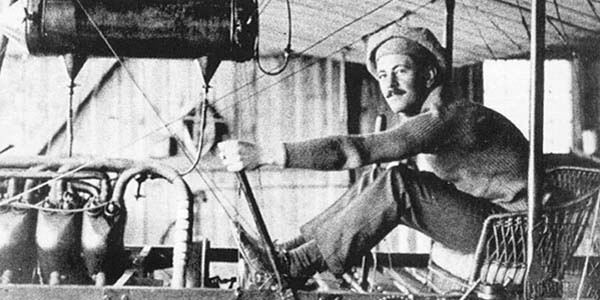
While working on the novel “Tsingtao–Vienna–Kyiv”, I accidentally discovered a little-known historical figure — Viktor Klobučar, a Croatian officer of the Austro-Hungarian Navy and one of the pioneers of naval aviation.
While working on literary works, I find it meaningful to reintroduce notable Ukrainian figures—unjustly forgotten by history—to a wider audience.
To some extent, I don’t even like the idea of using fictional characters in literary works. After all, we have so many real people whose lives unfolded in ways no playwright or writer could ever invent better.
It is enough to take, for example, the documentary books of Roman Kovalyov, which are based on memoirs and archival documents. They contain such characters and such fates that one could make captivating films or write books in any genre.
On the other hand, with the help of a fictional character, you can bring together dozens of historical figures within a single work, and thus convey more important details to the audience, offering a certain vision of the era. This technique is very well demonstrated in the HBO series Rome
In my novel “Tsingtao–Vienna–Kyiv”, there are many Ukrainian historical figures, as well as representatives of other nations. And I would like to tell separately about one of them—or rather, about how I came to discover him.
It all began when I accidentally came across his surname. Since the Austro-Hungarian cruiser “Kaiserin Elisabeth” appears in the novel, I needed an officer from that ship. I initially conceived him as a composite character, without any connection to a real prototype.

But I still needed a name. And then, in the memoirs of the German aviator Günther Plüschow (who also appears in the novel as a character), I came across the surname Klobučar. Fine—it would do. He was supposed to appear in two episodes, say a few lines—and that would be it.

However, that brief mention in Günther Plüschow’s memoirs intrigued me. First of all, what was his given name? Second, what was his nationality? That matters for describing the character. Third, the phrase “ex-aviator” sounds quite unusual for 1914—aviation was only just emerging at the time! Pilots were admired by everyone. Why would someone choose to leave that field?Moreover, the cruiser “Kaiserin Elisabeth” was both morally outdated and physically worn out. It was the kind of ship where very young officers might begin their careers—or, on the contrary, where those nearing retirement might be sent for an “honorable pension.” So what was this “ex-aviator” doing there?And finally, how should his surname be spelled correctly? The book is written in English, but the spelling of surnames—at least Mullerskowski—clearly looks German…

There is a second mention of Klobučar in Günther Plüschow’s memoirs that intrigued me even more. It turns out that during the Siege of Tsingtao, he and Plüschow managed to build a seaplane biplane! So much for an “ex-aviator”!

I was intrigued. On the internet, all mentions of “Klobučar” led to Amy Klobuchar—clearly not the right person.
In an Austrian study on ships of the First World War, there is a fairly extensive section about the “Kaiserin Elisabeth.” It mentions her commander—Captain Second Rank Makovicz—and includes a list of the fallen, among whom there are two Slavic surnames, but Klobučar is not among them.
From documents of the Austrian naval authorities published online, I was able to learn that Lieutenant Viktor Klobučar served in Tsingtao aboard the “Kaiserin Elisabeth.”
So now we know that his name was Viktor. The spelling of his surname is completely different from what appears in Günther Plüschow’s memoirs, but he was likely writing from memory—and Slavic surnames are not easy for Germans…
Further searches (using various possible spellings of the surname) yielded materials from Croatian, Polish, Czech, and Hungarian sources.
It turned out that he was Croatian, and his full name was Viktor Klobučar-Rukavina von Bunić (or, in Croatian form, Klobučar-Rukavina od Bunića). He lived from 1878 to 1965 and was the son of an Austrian general.
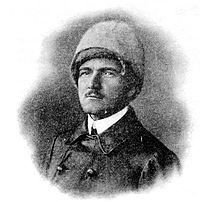
With this information, the search became easier, and I even managed to find several articles in Croatian dedicated to this person. And, it must be said, there was plenty to write about. Viktor Klobučar was the founder and the first commander of Austro-Hungarian naval aviation
But let’s start from the beginning.
He graduated from the Naval Academy in 1896 and served on ships of the Austro-Hungarian Navy. From 1902, he took part in flights on army balloons as an observer.
The idea of flight captivated him. Klobučar became an enthusiast of aviation, obtained a balloon pilot’s license (number 33—meaning he was the 33rd in Austria-Hungary) from the Austrian Aero Club. He followed aviation news and attended airshows. In 1909, he was sent on assignment to France, where he learned to fly, though he did not receive a pilot’s license.
After returning, he trained at an Austrian aviation school and in Frankfurt am Main. He received pilot’s license No. 26 from the Austrian Aero Club.

In 1911, Viktor Klobučar took part in the “Circuit of Britain” air race for the prize of the Daily Mail. Those who have seen the 1965 film Those Magnificent Men in Their Flying Machines (also known as “The Great Air Race”) are not mistaken—this race was one of the inspirations for the film’s сюжет.

Viktor Klobučar flew together with Lieutenant Bier in a “Taube” aircraft (which explains his appearance in Günther Plüschow’s memoirs: he offers his assessment of the situation, and Plüschow himself also flew a Taube in Tsingtao).
The Austrian aviators did not have much luck. During the first stage of the race, they were forced to turn back due to problems with the propeller (Plüschow would later write about similar issues already in Tsingtao).
During the second stage, their engine failed, and they were forced to make an emergency landing.

During the third stage, they again had to make an emergency landing, in which Bier was injured, and Klobučar had to continue alone. However, they had lost too much time and were forced to admit defeat.

Viktor Klobučar and the Creation of Austro-Hungarian Naval Aviation
Meanwhile, in 1910, the commander of the Austro-Hungarian Navy ordered the creation of an experimental naval aviation unit.
Viktor Klobučar was appointed commander of the unit. At first, the Austrians attempted to build their own seaplane, but the process dragged on. Klobučar donated his own Farman aircraft to the navy, though it was damaged during transport from France. They also tried to convert it into a seaplane.In search of suitable equipment for the Austro-Hungarian Navy, Klobučar ordered a flying boat from a Franco-British company, which became the eighth aircraft of the Austrian fleet.

With several models of experimental aircraft at his disposal, Klobučar carried out the first takeoff from water in the Austro-Hungarian Navy. He also took part in the first group flight over the Adriatic.
Under his leadership, a naval aviation school and a technical school were established. He also developed and planned the basing system of Austro-Hungarian naval aviation and created several naval air bases.

This continued until 1913. In that year, Admiral Count Montecuccoli was replaced as commander of the fleet by Admiral Anton Haus.
Here the sources provide differing accounts. According to official records, after an accident (two aircraft crashes in which he was injured), Viktor Klobučar was transferred to the technical committee in Pula, the main base of the fleet, and from there—to the “Kaiserin Elisabeth” as an artillery officer (his original naval specialty).
Another source claims that he ended up on the deck of the old cruiser due to a misunderstanding involving a married woman.
Unofficial sources describe a dispute between him and the new commander regarding the role of aviation in fleet operations, which ended with insulting remarks directed at the admiral.
This version seems more plausible, since sending a specialist with such experience to an outdated ship in a colony appears highly illogical. Moreover, Klobučar did not lose his interest in aviation: as already mentioned, he and Günther Plüschow were building a seaplane during the Siege of Tsingtao.

After returning from Japanese captivity in 1920, he joined the Yugoslav Navy, where he became head of the naval section of the General Staff, and later commanded the cruiser “Dalmatia.”
In 1931, he retired from service. After that, he was engaged in public activities and became the author of books and articles on naval topics.
What a remarkable person! And I had planned to limit him to just a few lines in two episodes! It even made me feel a bit ashamed. I gave careful thought to the kind of worldview such a person must have held—and his role in the novel “Tsingtao–Vienna–Kyiv” was significantly expanded.
One of the Croatian articles about Klobučar concludes with regret that the name of such an extraordinary person has not been honored in any way in Croatia.
Thus, his appearance in my novel becomes a tribute to the friendly Croatian people.
The figure of Viktor Klobučar became one of the historical prototypes for characters in the historical novel “Tsingtao–Vienna–Kyiv”, where the events of the First World War and the Ukrainian Revolution are portrayed through the lives of both real and fictional figures.
Previous materials related to the topic:
In search of a lost aircraft depot (in Ukrainian)
About Shevchenko and the calendar

 English
  Українська
5 thoughts on “Віктор Клобучар — хорватський піонер австро-угорської морської авіації”